

The Code Brutalist
Rough Edges of Digital Design
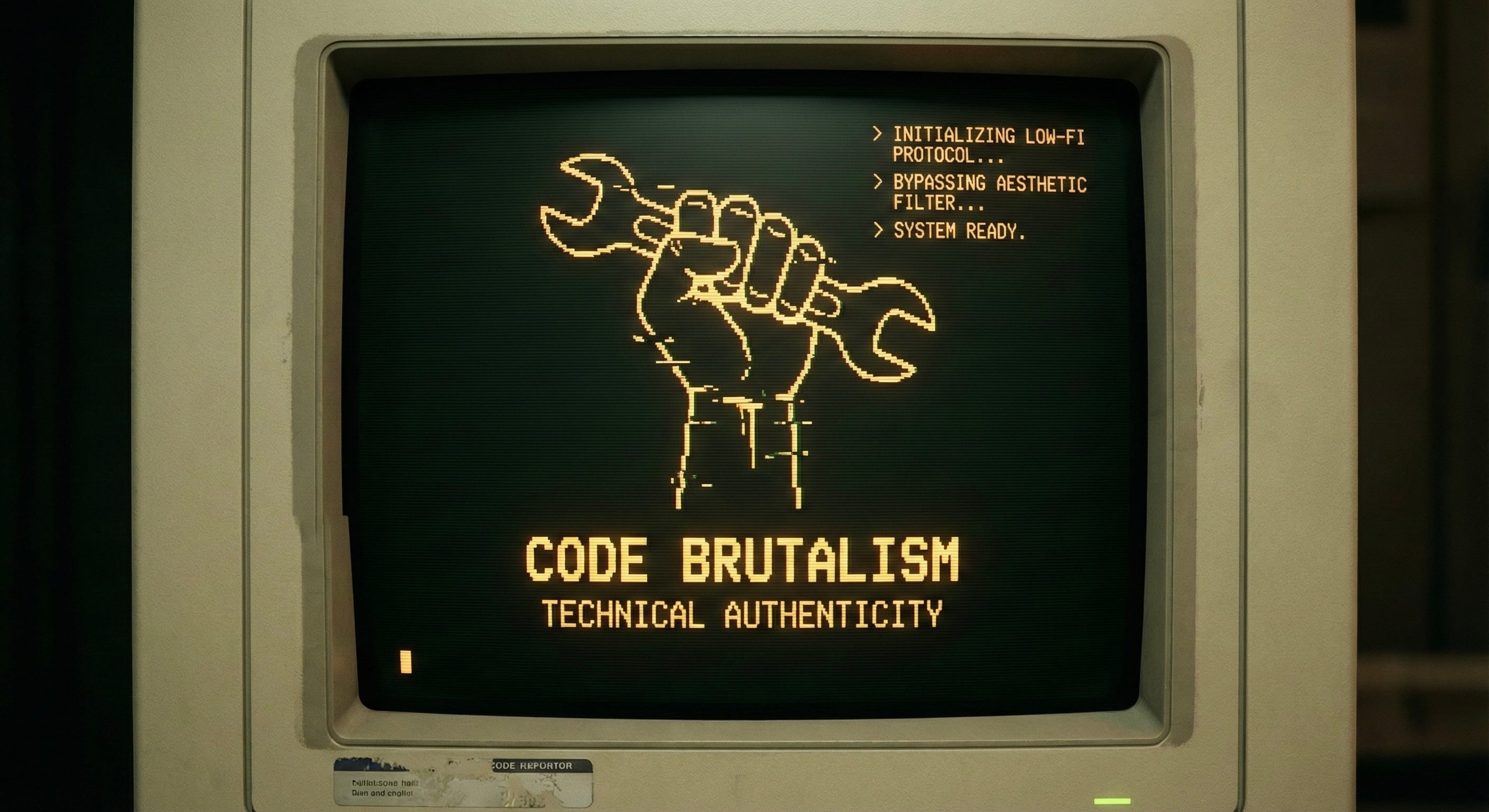
In a glass-walled studio in Berlin, a lead designer is deleting a folder of high-fidelity 3D renders. For weeks, his team has been polishing a brand identity that looks exactly like every other “premium” tech startup: soft gradients, rounded corners, and hyper-realistic glass textures. It is beautiful, expensive, and entirely invisible. He realizes that in a world where everyone has access to the same “infinite polish” button, the only way to signal actual human labor is to strip the UI back to the bone. He opens a prompt window, not to ask for a masterpiece, but to ask for the visual equivalent of a concrete bunker. He is looking for the “Code Brutalist” aesthetic to challenge the smoothness of the ubiquituous simulacra.
For the last few years, AI tools have been used to generate a relentless stream of glossy, over-saturated imagery that feels increasingly like a statistical average of the internet’s most generic desires. This “View from Nowhere” style has become a liability for brands that need to project technical authority. When a company uses a hyper-realistic AI spokesperson, the subtext isn’t “we are high-tech”; it’s “we are hiding something behind a filter.” The shift toward Code Brutalism is a direct reaction to this saturation of the synthetic. It is a move away from the “symphony” of professional rendering and toward the mechanistic honesty of a terminal window.
This isn’t a return to the primitive because of a lack of skill; it is a calculated unbundling of the traditional “polished” design. Designers and builders are using AI to assist in creating interfaces that look like they were typed into existence by an engineer in 1984. They are utilizing LLMs to generate complex ASCII art, monospaced typography systems, and layouts that prioritize raw data over eye candy.
Instead of hiring a team of illustrators to create custom icons, a designer might prompt an AI to generate a series of 1-bit, pixelated glyphs that look like they belong on a retro calculator. They are treating the AI as a high-speed generator of “low-fidelity” assets. This creates a brand identity that feels rugged and “heavy,” standing out against the lightweight, airy aesthetic of the standard startup, ignoring the pressure to be neutral or comprehensive.
The message is clear: the most sophisticated thing you can do with a trillion-parameter model is to make it act like a typewriter.
Sources
Medium: Aesthetics in the AI era: Visual + web design trends for 2026 V
itrina AI: How Generative AI is Disrupting Animation Production Pipelines 2026